

How To Draw A Kobold Head
Do–But Not Work
We are fierce believers that drawing the man face takes practice, but it isn't piece of work. That is because at that place are rules to follow and an effort to put behind it, but the procedure isn't anything only something to revel in if you have artistic leanings.
So enjoy more than a dozen tips on drawing the human head from one of our favorite artists Paul Leveille and and so come across about further embarking on a portraiture voyage with the sketches and insights from Everett Raymond Kinstler, a seasoned expert whose volume,Impressions and Observations, is a must-take for learning artists.
Commencement, It's Not a Race
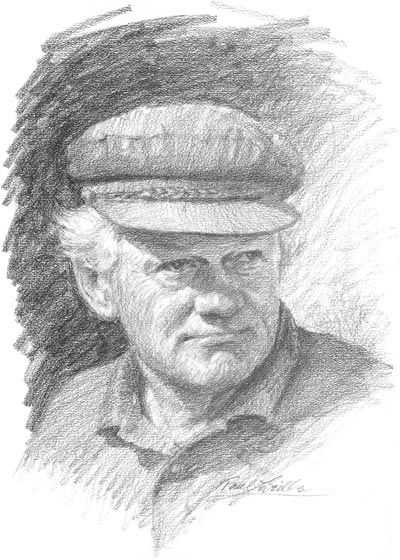
Drawing the human being head correctly takes practise, only I never consider it work. To me, people are the most fascinating subjects to study and to describe. There's no chance for colorlessness since there are millions of unlike faces in this world. Even the aforementioned person takes on many looks with diverse expressions, clothing and lighting. In this article, I'll discuss the planes, features and proportions commonly used for drawing the "ideal" head.
Start, while you're learning to draw a portrait, go along in mind that you're not in a race. Relax and progress at your own pace. As long every bit y'all keep drawing, yous'll move forward. Then pick up your pencil and savor the journey.
Brainstorm With Simplified Planes
You tin simplify the structure of the human caput by eliminating details and breaking downwards the many shapes into a few bones planes (meet Planes, beneath). Exercise drawing these heads or, better yet, try working from a planed plaster (or plastic) bandage. One time you lot feel more familiar with the caput, start drawing from a live model.
Whether yous're working from a cast or a live model, it'south important to utilize one main light source to accentuate the planes. In the drawings hither, the calorie-free source is above and to the left of the head. This particular lighting defines the features best by leaving shadow areas under the eyebrows, the olfactory organ, the upper lip and the chin. This lighting placement is one of the near desired for portraits since it reveals the forms of the features most effectively.
Planes
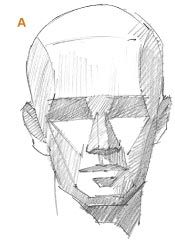
A Divide the area from the cheek down to the jaw into 3 bones planes: lite, where the light source is brightest; darker, every bit the form starts to plow from the calorie-free; and darkest, equally the class turns farthest from
the light.
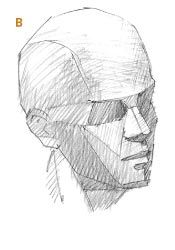
B The way lite is revealed on the planes of the head tells united states how the head is shaped. Here, the jaw is dark because it turns back, away from the light. Past contrast, the ear is much lighter because information technology turns out from the jaw and catches the light.
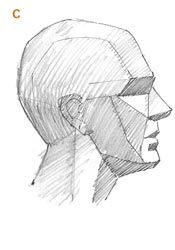
C The top and the back of the head accept the aforementioned appearance that a ball lit from in a higher place would have. Starting from the top of the head—the brightest area—the head gets progressively darker as the planes turn from the light to the back of the head. This subtle value shift produces the look of a rounded structure.
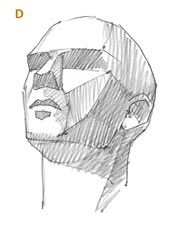
D Try cartoon the caput in simple planes in a variety of positions. Remember to leave out details—eyes, eyebrows, nostrils and other features—at this stage.
Render Head and Features
From the simplified planes of the caput, we now progress to the study of the head and facial features (come across Head and Features, below). At this betoken, I'd similar you to squint at these drawings. Squinting allows you to eliminate the details of the features and meet merely the big shapes — the planes.
Head and Features
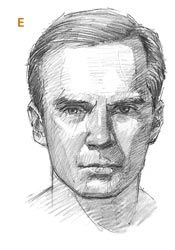
Due east The big planes are nevertheless visible, only they're softer. For example, the transition from calorie-free to dark on the cheeks is more than subtle. The eyes stay back in the shadow plane nether the brows and are darker than the forehead and cheek areas. The only vivid light is in those highlighted areas.
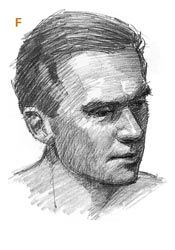
F This pose reveals the overall roundness of the head. The brightest areas appear on the model'south right forehead, the pilus above the cheek, and the oral cavity surface area below the nose. As the forms turn abroad from the light, they become darker.
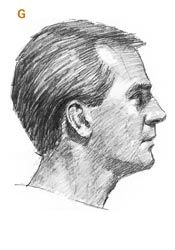
G We've seen the subtle changes in planes on the cheeks. This pose reveals the dark planes acquired past the canopy effect of the eyebrows, olfactory organ and jaw.
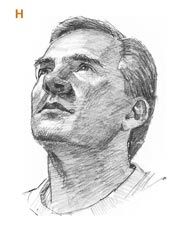
H The next pose lets us see what happens on the shadow side of the caput. A lot of the planes are defined by reflected light. For instance, the ear is entirely in shadow, only because information technology's turned at a slight angle to the caput, it's picking up more reflected light. Keep in heed that even though the ear is lighter than the planes around information technology, it's still in shadow and therefore darker than features on the lite side of the face.
Developed Caput Proportions
All developed heads expect unlike, and notwithstanding they all have ii optics, two ears, a nose and a rima oris. When I work from a model or a photo, I start by lightly drawing the fundamental proportions in pencil or charcoal. So I make adjustments specific to my item field of study as I proceed by concentrating on what I meet (to a higher place).
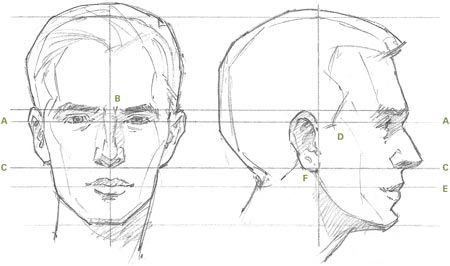
A From the peak of the caput to the chin, the optics are positioned approximately in the heart.
B The eyes are nigh ane heart-width apart.
C The bottom of the olfactory organ is halfway between the eyebrows and the chin.
D The ears are positioned between the horizontal lines of the eyebrows and nose.
E The oral fissure is placed between the olfactory organ and chin, about two-thirds of the style up from the mentum.
F On the profile, notice that the ear is placed backside the vertical middle line.
This article features excerpts from the bookDrawing Expressive Portraits past Paul Leveille.

Source: https://www.artistsnetwork.com/art-mediums/drawing-human-head/
Posted by: mcculloughglelavold.blogspot.com
0 Response to "How To Draw A Kobold Head"
Post a Comment